
THE NAFSYCHOLOGY FOUNDATION SEQUENCE
The Art of Nafsychology™
Refinement in Proportion
Nafsychology is an educational, ethics-first project for psycho-spiritual refinement, using psychological typology as map-language under Islamic guardrails.
This page is the public landing page for the three-book Foundation Sequence. Book One is nearest to publication and therefore receives the most detail here. Books Two and Three are visible at a high level only.
Book One subtitle: A Guided Journey Through Jungian Typology Under Islamic Guardrails
Jump to: Foundation Sequence · Book One at a glance · What Book One does · Two registers, one journey · The guardrails · The organizing scaffold (high-level) · Book Two (high-level) · Book Three (high-level) · Micro-FAQ
Monthly Refinement Note (high-signal) · major milestones · publication only. No spam.
Educational only. No tests, scores, or typing. No diagnosis or therapy. No Fatwā.
The Foundation Sequence at a glance
The Nafsychology Foundation Sequence is a structured three-book foundation for psycho-spiritual refinement under Islamic guardrails.
Book One establishes the working psychological map and Paths of Refinement.
Book Two deepens shadow, unconscious compensations, and the deeper structural synthesis that keeps the first map honest.
Book Three foregrounds the spiritual faculties under authentic revelation as the higher measure.
Books One and Two establish the psychological foundation. Book Three carries the psycho-spiritual turn.
Book One is complete enough to begin and coherent enough to stand on its own. The full Foundation Sequence carries the larger architecture.
Book One at a glance
Book One begins with a wide-angle orientation to humanity’s attempts to describe the inner life, then narrows deliberately into a single working psychological map: Jungian typology.
From there, it gathers Jung’s original concepts and disciplined post-Jungian developments into a single organizing scaffold used for steady self-observation and proportionate refinement, without turning typology into identity theater.
Jung is used as a clarified starting map for structural reasons, not as a final authority. Claims remain modest and corrigible.
THE PROMISE
What Book One actually does
Restores typology to structure: moving beyond memes and shortcuts to the study of the psyche's functional architecture.
Trains clearer self-observation: “axes, not ladders” as a discipline of proportion, not ranking.
Enforces sources discipline: Jung’s texts are distinguished from later elaborations, and from our organizing choices.
Builds practice scaffolding: language and cadence designed to survive ordinary pressure, not ideal days.
Keeps accountability intact: insight stays answerable to a higher measure, so explanation never becomes an exemption from character work.
Online we remain high-level. Diagrams and complete mappings remain books-only until publication.
Two registers, one journey
Book One is carried by two complementary registers. The Guide opens the doors, orients the reader, and relieves cognitive load at the hinges. The Analyst lays out the definitions, sources, and architecture with restraint.
The design is deliberate: imagination opens; analysis steadies.
Book One parts at a glance
Part 1: Orientation and first principles
Part 2: Jungian typology, clarified (working map)
Part 3: Practice scaffolding for return to proportion (Paths of Refinement)
What we mean by “Art”
“Art” here does not mean aesthetic self-expression. It means craft: disciplined seeing, precise language, and proportionate application over time.
This is why the Foundation Sequence avoids “quick wins.” It builds a structure that can survive ordinary pressure, not only quiet reflection.
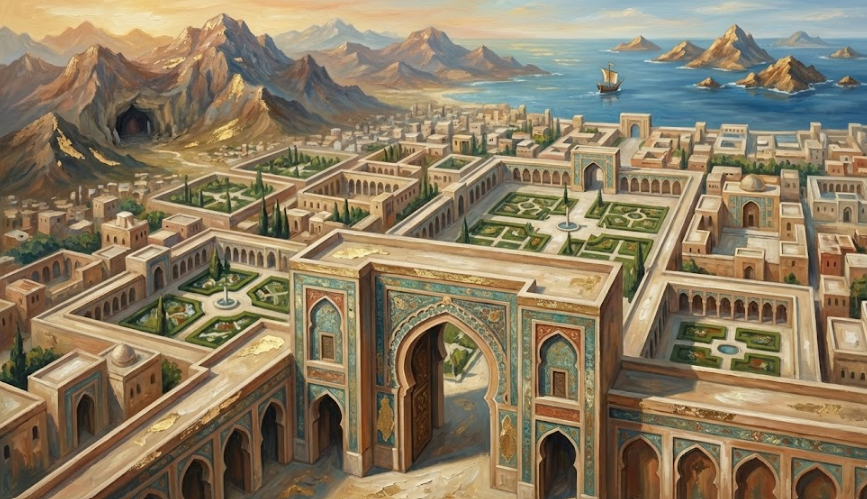
Book One: Enter the city and learn its working map.
What we borrow, what we refuse, and why
Jung is a starting map, not a final authority
We begin with Jungian typology because it offers a coherent architecture of tradeoffs and compensations. We do not adopt Jung’s metaphysical assumptions, nor do we treat Jung as morally or spiritually authoritative.
Traditional Islamic teachings set the guardrails
Traditional Islamic teachings on refinement function here as ethical and theological constraints, preventing category errors and resisting identity theater.
No equivalence claims
Typological language is used as descriptive map-language. Resonances may be noted as limited analogies, but typological constructs are never equated with revealed categories.
The organizing scaffold used across the psychological foundation (FSM)
The Functions Spectrum Model (FSM) is the organizing scaffold used across the psychological foundation. It maps psychological functions and attitudes across tensions and compensations. It maintains a firm boundary against reduction, deliberately preventing the collapse of human beings into rigid categories, caricatures of personality, or psychological horoscopes.
What it is for (high-level)
Clarifies tradeoffs and compensations
Supports steadier self-observation under pressure
Keeps psychological typology descriptive, not verdict-making
The structural correction
Many popular presentations of typology arrange functions as ranked stacks. When handled poorly, this can train a hierarchy of self-regard: the upper positions are treated as worth cultivating, while the rest become weakness, nuisance, or shadow.
The FSM responds by reading functions through axes of tension and proportion. In this model, growth is not optimization of a favored strength. It is the steady work of keeping necessary human tensions in proportion, rather than resolving them by suppression, so the map supports refinement rather than ego-ranking.
The fuller architecture, including the tension mappings, compensatory patterns, and practice scaffolding, remains books-only until publication. This ensures the system is delivered with the exact interpretive frame it requires.
Book Two (high-level)
Book Two remains a psychological book under Islamic guardrails. It deepens the first map by turning toward shadow, unconscious compensations, and the deeper structural synthesis that keeps conscious refinement from becoming naïve.
The public site names that second movement at a high level only. Its deeper internal architecture remains in the books rather than online.
Book Two: Descend below the paving stones and meet the counterforces that correct the map.
Book Three (high-level)
Book Three carries the psycho-spiritual turn. It foregrounds the spiritual faculties under authentic revelation and is organized for non-specialists with scholarly restraint.
Psychology remains counsel, not crown. Its language stays disciplined and supportive, never dominating or asserting authority over revelation.
The guardrails do not begin there; they become more explicit there.
Book Three: Return to the heart of the city to find who was always meant to govern it, crowned at last under revelation.
Micro-FAQ
-
It is the name of Nafsychology’s three-book publishing arc. Book One establishes the working psychological map, Book Two deepens its hidden counterbalance, and Book Three foregrounds the spiritual faculties under authentic revelation.
-
No. It is the shared title across the three-book Nafsychology Foundation Sequence. Each book carries its own subtitle. This page functions as the sequence landing page while remaining weighted toward Book One, which is nearest to publication.
-
Yes. Book One is complete enough to begin and coherent enough to stand on its own.
The full Foundation Sequence carries the larger architecture, but the first book is designed to be genuinely usable rather than merely preparatory.
-
Only high-level descriptions. The public site is intentionally higher-level than the books so deeper internal architecture cannot be reverse-engineered out of context.
-
No. Nafsychology is not presented as a new revealed typology, clinical system, or closed psychological school. It is a structured synthesis: we stay close to primary texts, distinguish sources from later elaborations, and clearly signal where our own organizing interpretation begins, keeping claims modest and corrigible.
The contribution is in disciplined arrangement, guardrailed application, and practice scaffolding for refinement in proportion.
-
Because it offers a mature, internally structured psychological map with a long interpretive lineage.
We begin there as a disciplined first map, with explicit limits, not as a claim that Jung is complete or supreme, nor that his “type theory” exhausts the domain of psychological typology.
-
They function as ethical guardrails and higher-order constraints. We use Islamic concepts to orient the work of refinement, not as clinical protocols.
Crucially, we maintain a strict separation of categories: typological constructs are never equated with the spiritual faculties defined by revelation, nor is the rigorous methodology demanded by either tradition diluted for the sake of synthesis.
-
No quizzes, psychometric scoring, or automated typing. Instead: definitions, observation across time and context, and ethical limits that keep typology descriptive rather than moralizing.
Where formal assessment belongs in clinical or research settings, it requires qualified use and narrow claims; that is not the lane this project occupies.
-
Reserved for the published books, where full context travels with the material.
Online, we remain deliberately high-level to protect readers from half-digested fragments and to prevent diagrams from circulating without the guardrails required to use them properly.
-
We discourage snap typing and premature certainty. The work emphasizes observation over time and return to proportion, not verdicts.
Self-diagnosis is treated here as a risk to be managed with humility, not a selling point.
-
There are no memes, no “which character are you?” quizzes, and no reductions of complex people into caricatures. We treat typology as a serious language for proportion, limits, and long-form refinement; never as identity theatre.
-
Yes, if you value careful psychological typology without test-culture and want a disciplined ethics-first approach with explicit limits.
The theological claims and sources are stated plainly rather than smuggled in, allowing you to engage with the structural insights on their own terms.
We publish depth, not distraction. Details live in the books.
Monthly Refinement Note (high-signal) · major milestones · publication only. No spam.
Precise enough for practice, modest enough to be corrigible.
— Nafsychology™
Nafsychology™ is used as a trademark identifying this educational framework and its related materials. The Art of Nafsychology™ is used as the shared title of the book series. We assert common-law trademark rights and protection through use and, where applicable, registration or pending registration in relevant jurisdictions.
Unauthorized use of these names, marks, or distinctive materials in ways that imply endorsement, affiliation, or repackaging is not permitted.